
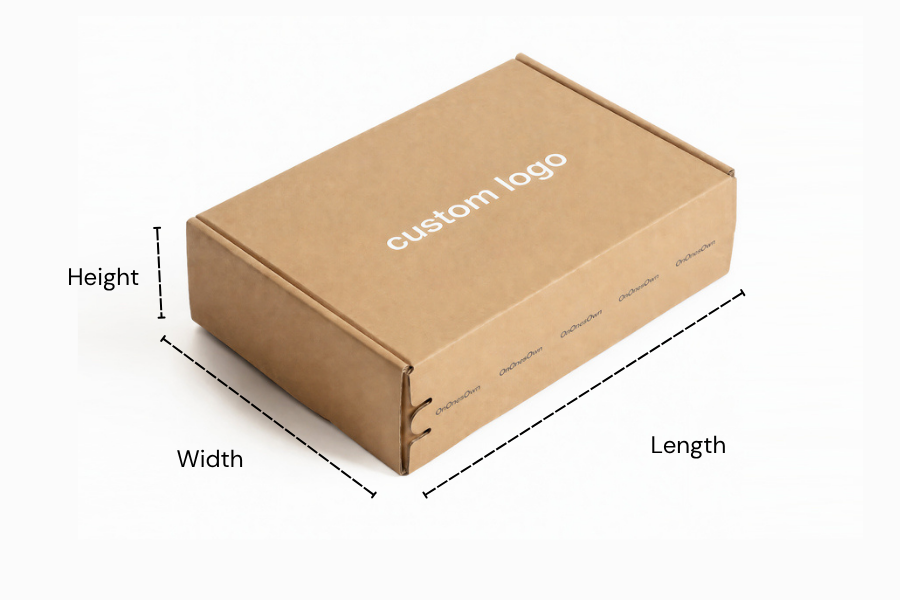
1. Standard Shipping Box Sizes
Shipping boxes are common in the e-commerce industry. If you want to customize shipping boxes with your own brand logo, you can not only customize them according to your own products, but also refer to the following common box sizes:
| Box Sizes | Dimensions (L×W×H) | Typical Use | DIM Weight (139 divisor) |
| Extra Small | 6 × 4 × 4 in | Jewelry, cosmetics, electronic components | 0.7 lbs |
| Small | 10 × 8 × 6 in | Paperback books, candles, small clothing | 3.5 lbs |
| Small | 12 × 9 × 6 in | Apparel, folded clothing, small electronics | 4.7 lbs |
| Medium | 14 × 10 × 8 in | Hardcover books, kitchen gadgets, boxed sets | 8.1 lbs |
| Medium | 16 × 12 × 8 in | Shoes with box, small appliances, auto parts | 11.1 lbs |
| Medium-Large | 18 × 14 × 12 in | Clothing bundles, tools, mid-size electronics | 21.6 lbs |
| Large | 20 × 16 × 12 in | Printer paper, folded garments, sporting goods | 27.6 lbs |
| Large | 22 × 18 × 12 in | Bedding, large apparel, bulky lightweight goods | 34.2 lbs |
| Extra Large | 24 × 18 × 18 in | Pillows, large electronics, bulky household items | 55.9 lbs |
*DIM weight figures use the 139 divisor for UPS/FedEx.
- Even small increases in box dimensions can significantly raise dimensional weight (DIM weight) and shipping costs.
- Most e-commerce products can be shipped efficiently using boxes between 10 × 8 × 6 inches and 14 × 10 × 8 inches.
- Oversized boxes often lead to higher freight charges, increased void fill usage, and lower packing efficiency.
- Lightweight products such as apparel, bedding, and pillows are especially vulnerable to dimensional weight pricing.
- Choosing a custom-sized shipping box can reduce logistics costs, improve sustainability, and create a better unboxing experience.
Carrier-Specific Options
USPS Flat Rate Boxes are one of the most effective ways to bypass dimensional weight charges entirely. Popular sizes include:
Small Flat Rate Box: 8.625 × 5.375 × 1.625 inches
Medium Flat Rate Box: 11 × 8.5 × 5.5 inches
Large Flat Rate Box: 12 × 12 × 6 inches
2. How to Measure a Shipping Box
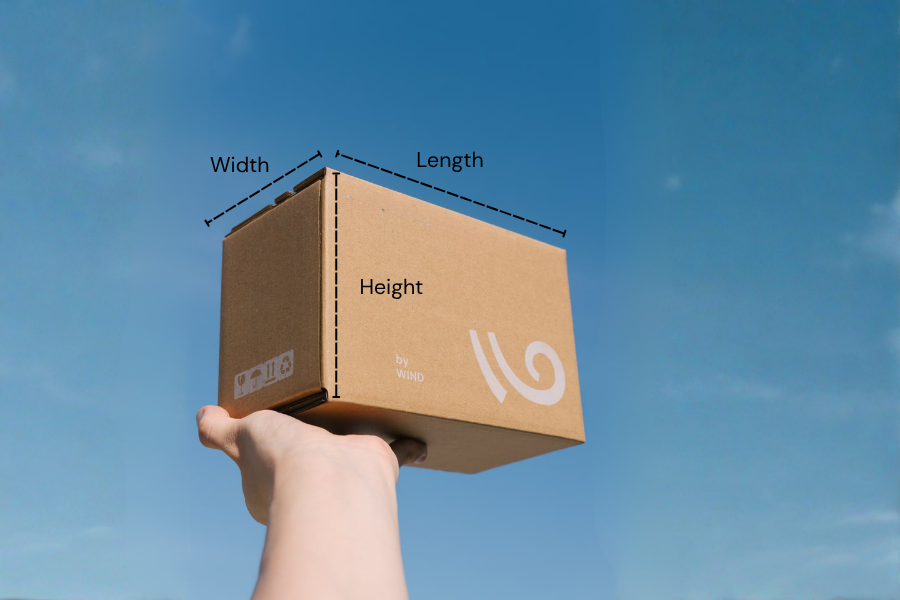
All box dimensions follow the industry-standard Length × Width × Height (L×W×H) format, used universally by UPS, FedEx, USPS, and box suppliers:
Length (L) — The longest side of the box opening
Width (W) — The shorter side of the opening
Height (H) — The vertical distance from base to top when assembled
A box listed as 12 × 9 × 4 inches is 12 inches long, 9 inches wide, and 4 inches tall.
Step-by-Step Measurement Process
Use a rigid measuring tool — A steel tape measure or ruler is recommended for accuracy. Avoid flexible cloth tapes that can stretch.
Measure fully assembled boxes — Always measure the outside of your assembled, packed box when getting shipping quotes. Manufacturers list interior dimensions—the usable space for your product. Carriers calculate shipping costs using exterior dimensions, which include corrugated wall thickness. The difference is typically ¼ to ½ inch per side.
Take three measurements per dimension and average them — This accounts for minor manufacturing variances.
Round up to the nearest whole inch or centimeter — This is not optional; carriers require rounding up for billing purposes.
Measuring Irregular Shapes
For irregularly shaped packages, carriers define dimensions as the smallest rectangular box that fully contains the shipment, including all packaging, handles, and protrusions:
Length — The longest side of the package
Width — The second-longest side
Height — The shortest side (or vertical dimension)
The formula: DIM Weight = (L × W × H) ÷ DIM Factor
New 2025–2026 Carrier Rounding Rules
Starting August 18, 2025, both UPS and FedEx began rounding every fractional dimension up to the next whole inch. Previously, dimensions less than 0.5 inches were rounded down; now a 11.1-inch dimension bills as 12 inches, 8.01 inches as 9 inches.
This synchronized policy change has a substantial cost impact. A merchant shipping 2,500 packages per month could see an estimated $32,000+ in extra annual costs from this change alone. Even small fraction-of-an-inch increases get rounded up, driving higher DIM weights and potentially pushing packages into surcharge categories.
3. How Does Shipping Box Size Affect Printing Cost?
| Box Size | 1,000 pcs | 1,500 pcs | 2,000 pcs |
| 14″ × 9″ × 4″ | $0.53 | $0.49 | $0.41 |
| 15.7″ × 13″ × 13.8″ | $1.44 | $1.32 | $1.17 |
| 20.2″ × 18.3″ × 6.9″ | $1.80 | $1.69 | $1.55 |
*Note: Pricing is based on custom corrugated shipping boxes with single-color logo printing. Prices are for reference only and may vary depending on material specifications, printing requirements, and order quantity.
4.Looking for a Reliable Shipping Box Printing Partner?
If you’re planning a custom shipping box project, consider not only your product dimensions but also protective packaging requirements, shipping methods, and logistics costs.
At Xinyi Printing, we help brands, e-commerce sellers, wholesalers, and distributors develop custom corrugated shipping boxes with optimized dimensions, durable construction, high-quality printing, and worldwide shipping support. Whether you need mailer boxes, subscription boxes, or large-volume shipping cartons, our team can help you find the most cost-effective packaging solution for your products.